 Ru
Ru Uz
UzSogdian inscriptions from the collection of the Samarkand State Museum Reserve. Inv No. BS-2.
Sogdian inscriptions from the collection of the Samarkand State Museum Reserve. Inv No. BS-2.
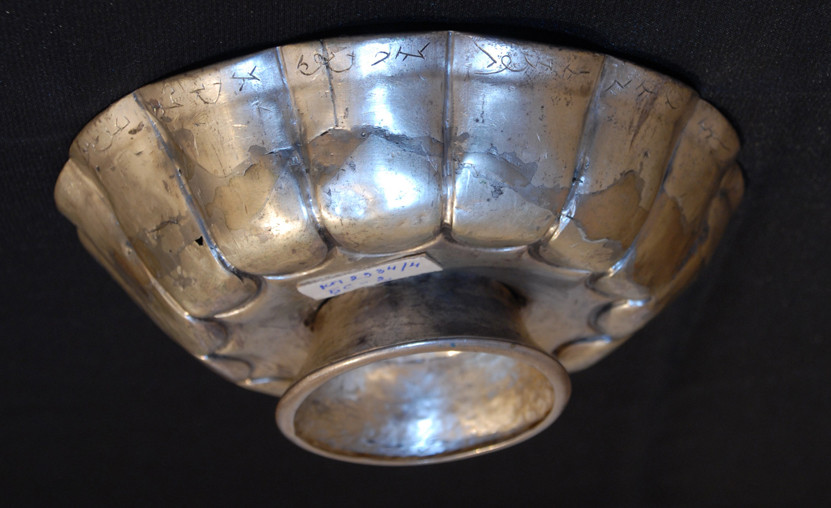
Inscription on silver bowl from Chilek. Samarkand region. Payaryk region. Chelek. Found while dig-ging a well in the summer of 1961 a. Certificate of 1961, the village of Chilek, Samarkand region. Samarkand Museum-Reserve, Numismatics and Special Storage Fund, Inv No. BS-2.
Physical description of the monument
Bowl. Silver, engraving, chasing. Purity 925, total weight—312.50 gr. The diameter of the rim of the bowl is 16.2 cm. Silver, rounded with a lobed border and an omphalo in the center. The bottom of the leg is conical, and the top follows the shape of an omphalo. The lower edge of the leg is bent inwards. The bowl is forged, very thin-walled, but with a wide rim along the inside of the rim and an omphalo that is more massive than the walls. In the center of the omphalo there is a hole from the leg of a compass. The lobes were hammered from the back. Traces of gilding indicate the orig-inal solid gilding. A Sogdian inscription is inscribed on the outside of the rim of the bowl, which covers most of the rim of the vessel. The inscription is cursive. The vessel was broken by the finder, several fragments of a thin section were lost, scratches, abrasions, loss of gilding, loss of fragments.
Transliteration
ZNHZY (y)’mk ZKn n’pcβzty-cyk δyγ-cy xypδ ’yw knpy ’YKZY XX s n’krtk
Translation
‘This vessel is the property of the head of the community (?) Dekhchi. Weight slightly less than 20 sil-ver staters’.
Notes
Silver bowl found from Chilek (Chilek is located north of Samarkand) can be attributed to 7th centu-ry, as well as the accompanying cultural layers. The cursive inscription is inscribed on the rim of the bowl, 1 line. As a result of the interpretation of the Sogdian inscriptions on the bowls, one can get a clearer idea of private property in the early medieval Sogd. Thin-walled bowls of simple work, obvi-ously, belong to the local Sogdian school of this century. Simple ornaments of the central rosette of the Chilek bowl are associated with Sogdian monuments. A tulip with five petals or a flower separat-ed from the stem by a small circle are known from the ornaments of the painting of Penjikent. Name dyγ-čy or δyš-čy can be compared with the name δxcy on the countermarks of silver drachmas from northern Tokharistan and the name of Dizhe, the ruler of Kesh at the beginning of the 7th century ac-cording to Chinese sources.
Bibliography
Лившиц В. А., Луконин В. Г. Среднеперсидские и согдийские надписи на серебряных сосудах / Вестник древней истории. 1964. № 3. С. 155-179.
Маршак Б. И. История Восточной торевтики III-XIII вв. и проблемы культурной преемственности / Под ред. В. П. Никонорова; вступит. статья Ф. Гренэ. Санкт-Петербург: Академия исследования культуры, 2017. С. 67-83. Рисунок 36, 36а.
Маршак Б., Крикис Я. Чилекские чаши / Труды государственного эрмитажа. Том X. 1969. C. 55-80.
Lurje P. Personal names in Sogdian texts / Iranisches Personennamenbuch II/8. Vienna: Verlag der ÖAW, 2011. P. 187–188.
Каталог памятников согдийской письменности в Центральной Азии, Самарканд, МИЦАИ, 2022,С.227-229.